

By Jordi Cabanas-Danés
A couple of weeks ago, my colleagues and I at the Doctoral School organized a decluttering afternoon. While some colleagues focused on sorting through physical documents, books, and overflowing cupboards, others jumped right into a digital decluttering: deleting old emails, purging files, and tidying their digital desktops. Beyond the immense satisfaction of throwing things away, it turned into an incredible bonding activity. We stumbled across old memories, shared laughs, and inadvertently released a lot of shared tension. Without reaching Marie Kondo’s level, it also made me reflect deeply on the psychological power of cleaning up.
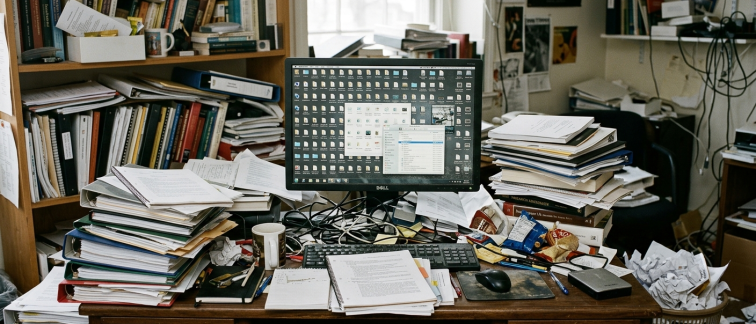
When I was doing my PhD, I remember collecting endless files and "articles to read" until they fully covered my PC desktop, forming a chaotic mosaic of icons. Every time I turned on my computer, that messy screen unconsciously cluttered my mind, presenting an overwhelming, impossible-to-finish to-do list. Guess what? I ended up graduating without ever opening or using most of those files anyway.
The hidden weight of physical clutter
When caught up in the daily momentum of research: experiments, submission deadlines, and everything in between; it feels efficient to save absolutely everything ''just in case.'' Spending an hour sorting files, let alone a full afternoon, feels like putting our academic progress in jeopardy. However, we often forget the efficiency that comes with working in a clean space. When your workspace is clear, your brain can direct its limited cognitive resources toward the complex task at hand, rather than wasting energy filtering out visual background noise. While we often tell children that a clean desk helps them study, scientific research shows this applies just as heavily to adults.1 Working in a chaotic environment significantly elevates your mental workload, making you much more prone to exhaustion and burnout.2
The constant drain of digital noise
Digital clutter is just as damaging. Hundreds of unsorted ''what if I need them later'' files act as tiny visual prompts that trick your brain into switching focus. Neuroscience shows that task-switching leaves a ''cognitive residue'', meaning a portion of your mental resources remains stuck on the previous ''task'', in this case a digital distraction, even after you continue with a new task.3 Furthermore, hunting for a single file through a messy digital labyrinth requires dozens of micro-decisions, which rapidly depletes your decision-making energy for the day.
The environmental footprint
Crucially, the cost of digital clutter extends beyond your brain to the planet. Every extra byte of data stored in the cloud carries a physical environmental footprint. Data centers run non-stop, consuming massive amounts of electricity and water not just to power the servers, but to keep the hardware cool enough to function. To combat this, try these quick digital habits:
• Empty the trash and spam folders: They still occupy server space until permanently deleted.
• Delete emails with heavy attachments: Filter your inbox by file size and search for heavy attachments. Download or delete them.
• Unsubscribe from non-interesting newsletters: If you haven’t opened a newsletter in three months, hit unsubscribe.
• Link when possible, don't attach: When collaborating on large drafts, share a cloud link rather than emailing heavy files back and forth.
The collective purge
If you want to tackle your own clutter, I highly recommend doing it with colleagues. There is something uniquely therapeutic about physically tearing up old, unneeded documents or hitting "Select All -> Delete" alongside colleagues who understand the stress of academia. Every time you decide you no longer need an item, you are actively freeing up space in your mind.
Imagine the feeling of walking into your office tomorrow morning to a clean desk and opening a completely organized computer. No distractions, no visual noise, just space to think.
So, ask yourself: Is dedicating an afternoon to decluttering really a waste of time? Or is it an investment in working healthier, protecting the environment, and focusing your energy where it actually matters?
References
- Nguyen, M. T., & Tran, N. U. M. (2025). The Impact of Workplace Environment on Concentration and Cognitive Performance: A Cognitive Psychology Perspective. GPH-International Journal of Social Science and Humanities Research, 8(8), 72-86.
- Ferrari, J., & Dao, T. (2020). The Negative Side of Office Clutter: Impact on Work-Related Well-Being and Job Satisfaction. North American Journal of Psychology. 22. 397-410.
- Leroy, S. (2009). Why is it so Hard to do My Work? The Challenge of Attention Residue when Switching Between Work Tasks. Organizational Behavior and Human Decision Processes. 109. 168-181.
Do you recognize yourself in this article? The PhD advisors are here for you. Get in touch with us for a consultation (phdadvisor@amsterdamumc.nl).