
This is the main finding from the 2025 HIV Monitoring Report for the Netherlands published by Stichting hiv monitoring (SHM) on 20 November 2025. Since 2010, the number of HIV diagnoses in the Netherlands was decreasing steadily, but the decline has stalled in recent years. In 2024, 444 new HIV diagnoses were registered.

infections is rising, and therefore we expect the number of new HIV diagnoses
to increase in coming years. These are concerning developments. By optimizing
testing policies and improving access to care and prevention, we may be able to
reverse this trend.'
After HIV infection, symptoms may take years to develop, often leading to delayed diagnosis. By the end of 2024, an estimated 1,610 people in the Netherlands are unaware they have HIV, up from 1,545 at the end of 2023. Those who are unaware and untreated can transmit the virus. Effective treatment not only protects individual health but also prevents further transmission.
Recent data show an increase in the proportion of men who have sex with men (MSM) diagnosed with a recent HIV infection—from 35% in 2020 to 42% in 2024. These individuals had a negative HIV test less than 12 months before their diagnosis.
“Diagnosing HIV in MSM at an earlier stage is a positive development, showing that more people in this group are getting tested regularly,” confirms Prof. van der Valk.
PrEP
New findings also show that a growing proportion of MSM and trans people with an HIV diagnosis have in the past used the HIV prevention pill PrEP, which stands for ‘pre-exposure prophylaxis.’ It is a daily pill that people who do not have HIV can take to reduce the risk of getting HIV if they are exposed to the virus. When taken correctly, including regular checkups with a prescribing physician, PrEP is very effective at preventing HIV infection.
In 2024, 19% of MSM and trans people with a new HIV diagnosis had used PrEP in the past, compared to 7% in 2020. PrEP has been available in the Netherlands since 2019, and SHM records past PrEP use among those newly diagnosed with HIV. Prof. van der Valk: ‘The longer PrEP is available, more people are getting prescribed, which is a positive development confirmed by our data. It is however also important to understand why people do not use PrEP consistently or stop using it.
By the end of 2024, the Netherlands has:
- An estimated 25,890 people living with HIV2
- 23,194 people with HIV in care
- 22,240 people with successfully suppressed HIV due to treatment (cannot transmit the virus)
- An estimated 1,610 people unaware they have HIV
- In 2024, 24 people died from advanced HIV infection (AIDS), a number that has remained stable since 2015.
Younger Generations
For the first time SHM’s annual report includes analyses looking at birth generations, providing more insight into the stalled decline in HIV diagnoses in recent years. An increase in HIV diagnoses among MSM born in the 1980s and 1990s, and also among MSM born from the year 2000 onwards, was found. Among MSM born before 1980, the number of new HIV diagnoses continues to decline.
Health Inequality
Socioeconomic and demographic characteristics of people with a new HIV diagnosis were also examined. Compared to the general Dutch population, people with a low income1, a migration background, or who use mental health care have a higher risk of HIV diagnosis. Health inequalities persist after HIV diagnosis: those with an income below the poverty line are less likely to have a suppressed virus and more likely to drop out of HIV care. Detectable virus levels are also more common among young heterosexual men and women.
These findings are also supported in two recent publications:
- Risk of new HIV diagnosis by intersecting migration, socioeconomic, and mental health vulnerabilities in the Netherlands: a nationwide analysis of the ATHENA cohort and Statistics Netherlands registry data - The Lancet Regional Health – Europe
- Harnessing registry data to identify socio-demographic and socio-economic gaps in HIV care in the Netherlands | Nature Communications

Number of HIV diagnoses and estimated HIV infections in the Netherlands, 2010–2024
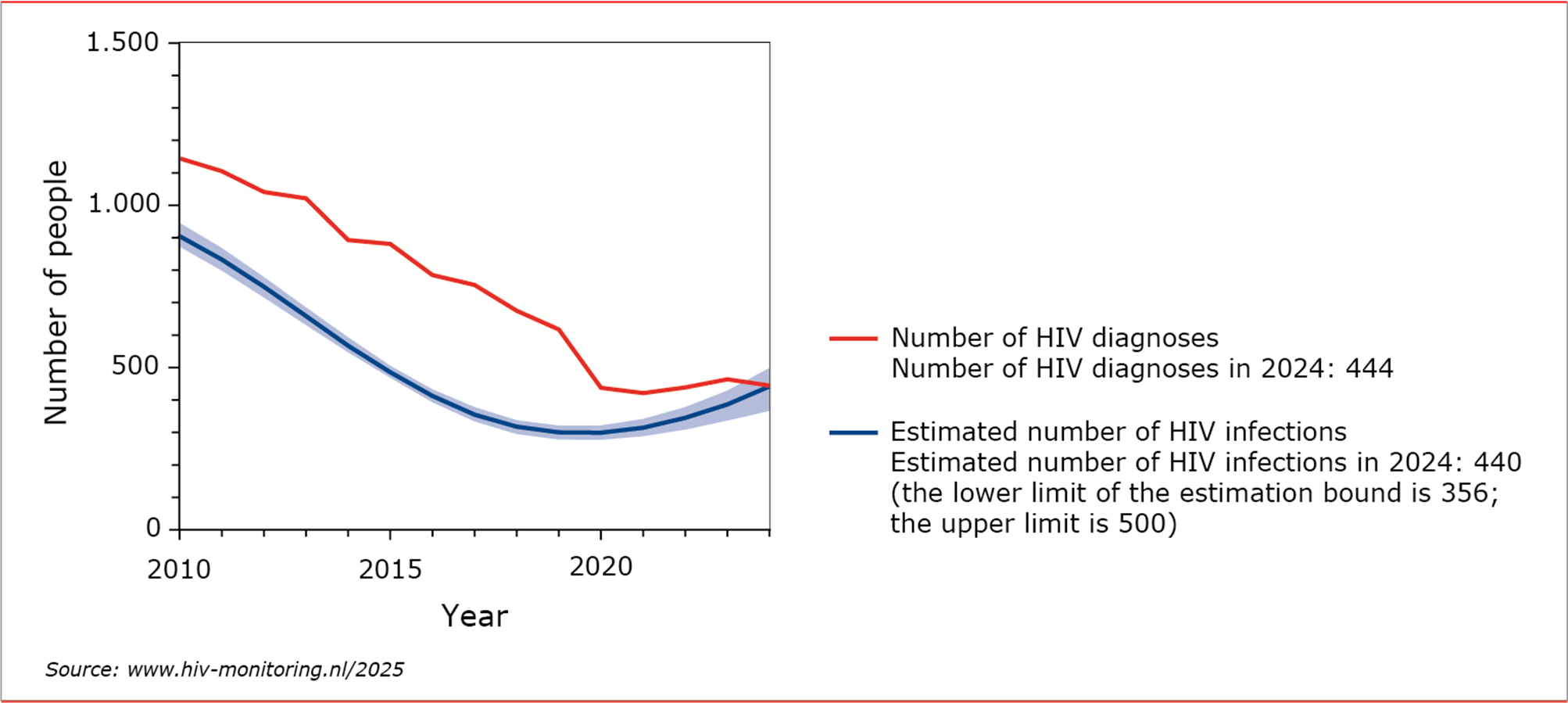
An acquired HIV infection is not the same as a confirmed HIV diagnosis. Often, several years pass between HIV infection and HIV diagnosis. The number of HIV infections over time is therefore not measured directly, but estimated using the number of diagnoses, mathematical models, and knowledge of how the infection progresses2.As a result, numbers of infections are always reported as estimates.
These and other data can be found in the summary of the HIV monitoring report.
Read our previous news articles on this topic here:
- The Netherlands on its way to zero new HIV infections (November 2022)
- Decline in HIV Diagnoses in the Netherlands Halts (November 2024)
HIV Monitoring Report for the Netherlands
Every year around World Aids Day, Stichting HIV Monitoring (SHM) publishes the annual HIV Monitoring Report for the Netherlands. The report provides a comprehensive overview of the current population of people living with HIV in the Netherlands. The report is commissioned by the Ministry of Health, Welfare and Sport and the Center for Infectious Disease Control of the RIVM, and in in close collaboration with the 23 recognized HIV treatment centers in the Netherlands, including Amsterdam UMC.
1 Low income is defined by CBS as 120% of the social minimum income. The government adjusts the social minimum income every six months. See also:www.uwv.nl/nl/toeslag/sociaal-minimum.
2 The number is estimated based on the annual new HIV diagnoses, using a method provided by the European Centre for Disease Prevention and Control (ECDC).