
The brain disease MS is characterised by lesions in the brain and spinal cord. Aside from these inflammations, damage can also be visible in the myelin, the protective layer surrounding nerve fibers. According to the researchers, myelin swellings are considered a precursor to MS lesions.
Dynamic damage
The research team used advanced microscopy techniques and different models to research the formation of this damage. This led to the discovery that myelin swellings have a dynamic character: they can not only grow, but also shrink and even recover completely. It also turns out that the activity of the underlying nerve fibre plays an important role; more activity of the nerve fibre leads to more and bigger swellings, while less activity allows for possible recovery.
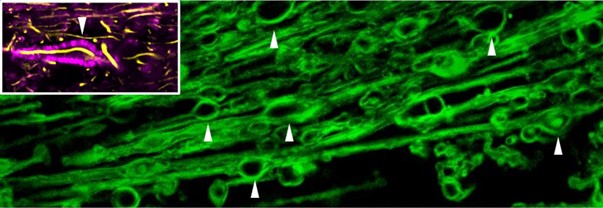 Myelin swellings as observed under the microscope from the VU LaserLab. Top left: myelin swelling fixed in MS brain material.
Advanced models
The strength of this study lies in the combination of different models and techniques, giving them the opportunity to study the processes in both animal models and human tissue in an identical way. In traditional brain research, the tissue structure is usually frozen with chemicals, making it impossible to determine the dynamic nature of the myelin swelling. Besides third-harmonic generation (THG) microscopy, also two-photon microscopy was used to study myelin changes in tissue in three dimensions and over time.
Beginning of myelin swellings
The next step is to explore why the activity of the nerve fibres can change the size and amount of myelin swellings. The researchers also want to study the role of brain cells in the appearance and disappearance of myelin swellings. Using the published model systems Maarten Kole (NIN), Antonio Luchicchi, Geert Schenk, and Niels Meijns (MS Center Amsterdam, Amsterdam UMC), and Marloes Groot (VU LaserLab), together with the team of David Lyons (Edinburgh), will seek to address these questions. Addressing this early damage, even before myelin is lost, could offer new treatment possibilities in the future for preventing tissue damage in MS and helping to keep myelin healthy for longer.
Read the publication in Science: Myelin sheaths in the central nervous system can withstand damage and dynamically remodel
This research is made possible by MS Centrum Amsterdam, Nationaal MS Fonds, Progressive MS Alliance, The Friends Foundation of the Netherlands Institute for Neuroscience, and NWO.