
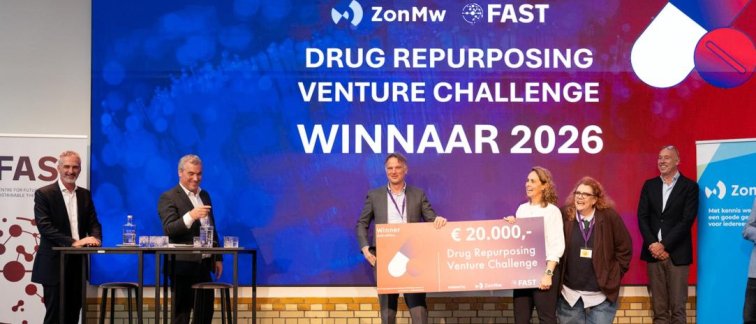
On 29 October, during the FAST 2026 event, Vergilius Therapeutics was announced as the winner of the Drug Repurposing Venture Challenge 2026. The Amsterdam UMC team, CCA’s Mariette Labots and Tanja de Gruijl and IXA business developer Pieter Slijkerman, received a cheque for €20,000 to further develop its treatment to prevent the recurrence of melanoma.
The jury praised the advanced stage of development, the convincing path towards a Phase III trial and the focus on affordability. Behind the prize lies a story that began twenty years ago.
A surprise in the data
"We did the first studies about twenty years ago," Tanja recalls. "Small, randomized studies, mainly to see what CpG did to the lymph nodes and whether it induced genuine immune activation."
CpG, the compound at the heart of the project, is a component of vaccines without registration as a medicine in its own right (yet)– an example of drug repurposing. Then something unexpected emerged: less tumor involvement was found in the treated lymph nodes. "At first I thought: that must be a coincidence," says Tanja. "But when we looked at the follow-up over time, the patients who had received CpG hardly had any recurrences, while in the other group recurrences kept occurring over eight years. Those were very beautiful findings, and we published them."
A larger randomized phase 2 study followed with equally promising results. By then, Mariette had joined the team.
One injection, few side effects
The treatment's strength is its simplicity. "It is one injection, given locally, at the spot where the tumour originally was located," Tanja explains.
The side effects are minimal says Tanja. "Whereas if the tumor comes back later, patients need very heavy immunotherapy, which can cause severe immune reactions. That is not what you want in these early-stage patients."
Learning to think like a company
The plans for a company are older than the challenge itself. "I had been talking to Pieter, our business developer, for many years about how we could do this," says Tanja. "Then the venture challenge came into view, and Pieter picked it up. We applied together, as a team of three." They were selected as one of four finalists for the second edition of the challenge, a joint initiative of FAST and ZonMw.
"You learn to think like a company. Who is your customer? It is not so much about selling, it is about explaining the value of what you have found," says Mariette. "It is really a learning trajectory: how can you bring your science further, through a company."
During two three-day bootcamps, the team refined its development plan. One key choice: focusing on dermatologists. "Dermatologists see these patients in the early stages, they can regularly give this type of injection, and the treatment fits well into their practice," Mariette explains.
From team name to spin-off
After impressing a jury of five experts with their final pitch on 7 October, the team was announced as the winner three weeks later.
Strictly speaking, Vergilius Therapeutics is not yet a company. "It is the intended name of the intended company," Tanja says. "We have secured the domain name, but the company has not been formally established yet." One option for the prize money is setting up the company and seeking advice on the road to registration.
We are very happy that we won. It feels like a stamp of approval from experts: there really is something promising here, and we should go for it.
The road to registration
Because CpG is an existing, off-patent component of vaccines, it cannot simply be registered as a new medicine. "That is always an issue with repurposing: these are existing compounds, and in our case the patent has long expired," Tanja explains. "So you have to find new ways to attach IP to it – for instance by specifying the target group, or by identifying biomarkers."
Registration will require a large, randomized Phase III trial, in Europe but possibly also in Australia and the United States.
Six or seven years to possible full registration
If all goes to plan, the first patient will enter the Phase III trial at the beginning of 2028. "If we manage to include many patients, a first interim analysis could be possible after two or three years, so around 2031," says Mariette. "If you then see a difference, you can sometimes already apply for provisional registration." Full registration could happen around 2033 or 2034.
The potential impact goes beyond medicine alone. "If fewer people end up at the oncologist, people can keep working for longer, and you save the costs of immunotherapy and of treating its side effects," Mariette calculates. "Taking part in this kind of study could actually pay for itself, in a societal sense."
The jury advised the team to further refine its business strategy and identify suitable partners, while safeguarding affordability. The team is now looking for investors and, with them, a future in which a single injection can keep melanoma from coming back.