

A narrative review published in Diabetologia examines how observational cohort studies have advanced knowledge of type 2 diabetes over the past five decades. The review includes cohorts from different regions and study designs, including three cohorts connected to Amsterdam Cohort Hub: the Hoorn Studies, the Hoorn Diabetes Care System cohort and RODAM.
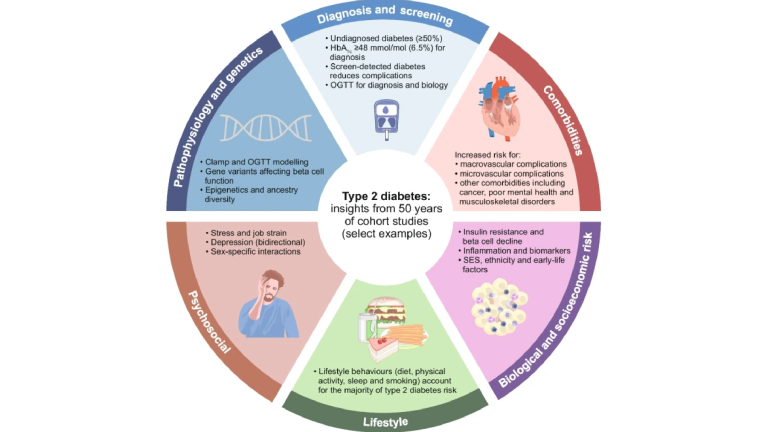
Cohort research has demonstrated that a substantial proportion of people with type 2 diabetes remain undiagnosed and has contributed to the development of diagnostic criteria, including the use of HbA1c. Long-term studies have also documented the wide range of complications associated with type 2 diabetes. In addition to microvascular and cardiovascular complications, these include cancer, impaired cognitive functioning, mental health problems, infections and musculoskeletal disorders.
The review describes how the studies have identified biological, socioeconomic, lifestyle and psychosocial risk factors. Research on insulin resistance, pancreatic beta cell function, genetic variation and biomarkers has further advanced understanding of disease development and heterogeneity.
Observational cohorts can examine long-term outcomes and exposures that cannot be assigned experimentally. However, the authors also identify limitations, including selection bias, confounding, differences in measurement and the underrepresentation of certain populations. Cohort findings therefore complement evidence from randomised controlled trials and experimental research.
Graphical Abstract
Contributions from ACH cohorts
Three cohorts connected to Amsterdam Cohort Hub are included in the review: the Hoorn Studies, the Hoorn Diabetes Care System cohort and RODAM.
The Hoorn Studies provided evidence on undiagnosed diabetes and on HbA1c as a determinant of retinopathy. The cohort also contributed findings on the relationship between psychosocial stress, chronic disease and mortality.
The Hoorn Diabetes Care System cohort demonstrated improvements in type 2 diabetes care associated with the chronic care model. Its data have also been used to evaluate prediction models for microvascular complications.
RODAM identified associations between type 2 diabetes and DNA methylation at loci including TXNIP and TPM4 among people of sub-Saharan African origin. RODAM-Pros examined associations between changes in the gut microbiome along the migration axis and cardiometabolic outcomes.
The review also cites HELIUS research showing that patterns of health-related behaviours associated with type 2 diabetes differ between ethnic groups.
Priorities for future research
The authors identify the exposome, precision health and real-world data as important directions for future cohort research. Combining longitudinal data with multi-omics measurements may support the identification of disease mechanisms, biomarkers and potential targets for prevention and treatment. Registry-based cohorts can complement clinical trials by providing evidence on the effects of interventions in routine practice.
The review also calls for more diverse and representative study populations, particularly in low- and middle-income countries. Greater cohort collaboration and responsible data sharing in accordance with FAIR principles will be important for generating and analysing increasingly complex datasets.
Read the full article in Diabetologia.