
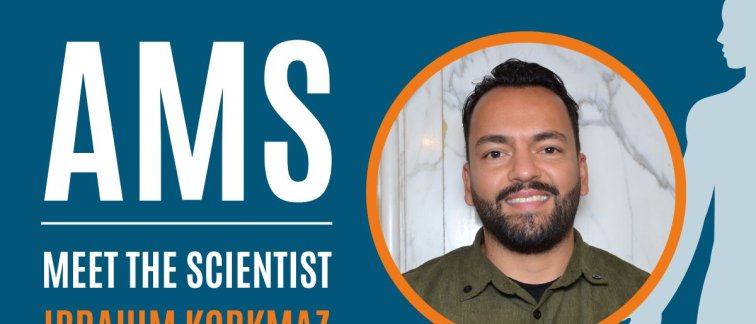
For Ibrahim Korkmaz, the skin is far more than a protective outer layer. It is a visible organ, one that tells a story about a person and its injuries. As a researcher and Assistant Professor at Amsterdam UMC, Ibrahim focuses on preclinical skin models to better understand wound healing, scarring, and particularly the complex immune response following burn injuries.
Ibrahim’s way into skin research is not a path much travelled. After completing a bachelor’s degree in Biomedical Sciences, he pursued a master’s in Forensic Science. There, he became involved in injury dating, analyzing inflammatory and coagulation markers in wounds to estimate how long ago they were inflicted, a method used in legal investigations.
While working with various types of injuries, he discovered that burn wounds behaved differently. This added another layer to his scientific curiosity. The inflammatory response in burns was prolonged in such a way that traditional dating techniques could not be applied. That observation sparked a deeper interest in burn-related inflammation and ultimately guided him toward a PhD focused on inflammatory responses after burn injuries
Another layer of Ibrahim’s work lies in education. Following his PhD, he continued as a postdoctoral researcher and now supervises PhD candidates and researchers as a faculty member. Although his primary focus has shifted toward burn wound healing, he remains involved in forensic research, mentoring students in that field and maintaining a connection to the discipline where his journey began.
What continues to motivate Ibrahim is the tangible impact of burn injuries. Unlike fibrosis in internal organs, scarring on the skin is visible. It affects not only function but also identity of a person and their quality of life. Through collaborations with the Burn Center of the Red Cross Hospital in Beverwijk and partners such as Euro Tissue Bank, he remains closely connected to the clinical reality behind his laboratory research.
The importance of his work becomes especially visible when major burn disasters occur. Following the recent burn incident in Switzerland, skin donations supplied through collaborations with Euro Tissue Bank were used to help treat patients. Although Ibrahim was not directly involved in the on-site response, moments like these bring sharp clarity to the purpose behind laboratory research. The donor skin that his team studies in controlled environments is the same type of tissue that can become life-saving in clinical emergencies. It serves as a reminder that behind every experiment lies a real-world application.
Through a combination of skin engineering, immunology, computational modeling, and education, Ibrahim works at the intersection of fundamental science and clinical relevance. His research aims not only to understand wound healing at a molecular level but also to improve real-world outcomes for patients living with the visible and invisible consequences of burn injuries. It is known that the skin has many different layers but so does Ibrahim Korkmaz.
This article is a repost of the AMS LinkedIn post about Ibrahim.
Written by Elianne Prange (Communication Officer AMS)