

Statistics Netherlands (CBS)
Linking Cohort Data to CBS: A Step-by-Step Guide
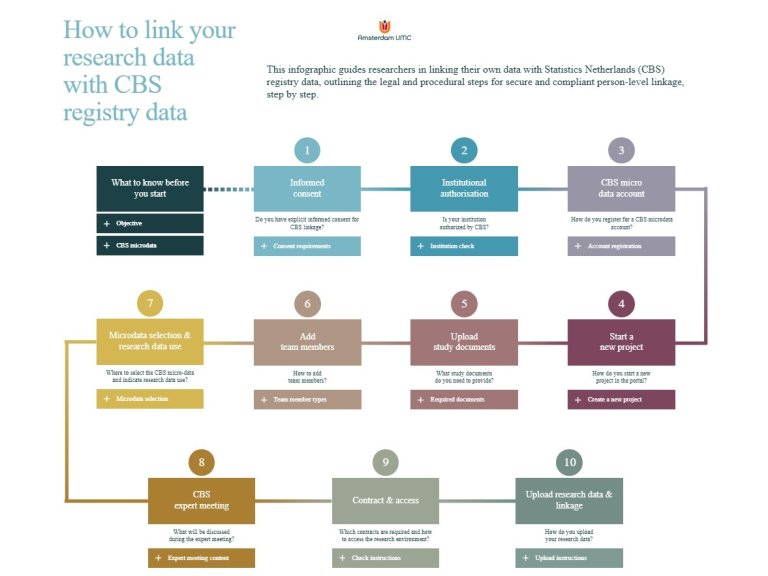
Statistics Netherlands (CBS) provides an extensive source of data on different topics. The so-called microdata from CBS are organized in different datasets, each of which contains information regarding various areas, such as social economic status, hospital data (e.g. diagnoses of hospital admission), medication data and cause of death. However, the technical and regulatory requirements of the linkage process can be daunting. To bridge this gap, the Amsterdam Cohort Hub (ACH) has developed two essential tools to guide researchers through the process:
- A comprehensive step-by-step manual: A deep dive into the legal, procedural, and technical requirements for secure linkage.
- An interactive infographic: A visual roadmap highlighting key milestones and decision points.
Both tools are now available to the research community at the Amsterdam Cohort Hub, Amsterdam UMC, and beyond.
Link to step-by-step manual:
Link to interactive infographic
ACH cohort support
Are you planning to link your data to Statistics Netherlands or another registry?
Please feel free send an e-mail to: cohortsupport@amsterdamumc.nl.
Geoscience and health cohort consortium (GECCO)
GECCO is a Dutch infrastructure to support researchers to study the relation between environmental characteristics and health. Learn how you can get [free] access to a wide variety of environmental data to use for your research.
GECCO is continuously expanding and improving the list of available environmental variables, and uses these data to enrich 25+ renowned and on-going large-scale Dutch cohorts.