

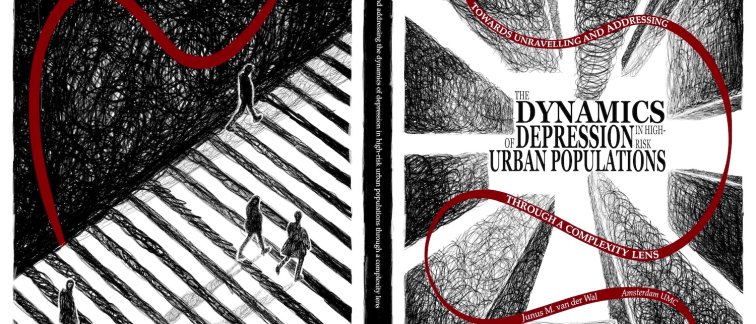
Depression remains one of the leading causes of disability worldwide, and epidemiological studies suggest that it is more prevalent in urban areas, particularly among socioeconomically and ethnically vulnerable groups.
In his doctoral research at the University of Amsterdam, Junus van der Wal used data from the HELIUS cohort alongside other longitudinal datasets to examine how depression develops in high-risk urban populations. By applying a complexity science perspective, he explored how factors at the individual, social, and urban level dynamically interact over time. He recently earned his PhD based on this work.
His findings show that depression in urban contexts cannot be understood as the result of a single risk factor. Instead, it emerges from interconnected processes operating across multiple levels, from ethnic discrimination and socioeconomic disadvantage to neighborhood characteristics and individual affect dynamics.
Key findings
Interactions between ethnic discrimination and socioeconomic position contribute to increased risk of depressive symptoms in ethnic minority groups.
- Depression develops through dynamic feedback loops between individual symptoms and environmental stressors.
- Interventions can act as “perturbations” in this system, potentially shifting trajectories of risk at both the individual and population level.
- Mental resilience at the population level can be studied using dynamical systems approaches, offering new insights for prevention strategies.
The study highlights the importance of addressing structural inequalities in urban environments and calls for mental health research and policy to adopt systems-based approaches.
Read the full dissertation here: Towards unravelling and addressing the dynamics of depression in high-risk urban populations through a complexity lens– University of Amsterdam