
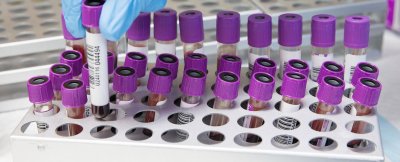
Establishing a fit-for-purpose biobank is logistically challenging and requires interaction with different service providers. The Biobank of Amsterdam UMC advises researchers about the necessary steps and the support that is available. Discussing plans with the Biobank at an early stage is therefore recommended. Different aspects need to be addressed:
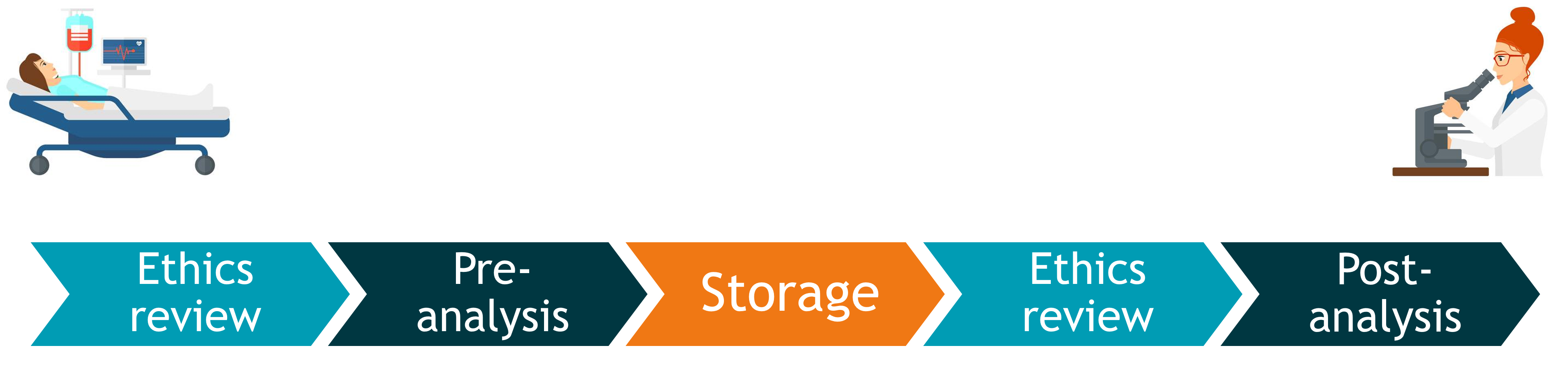 Biobank proces chain
Ethical & legal approval
Biobank activities need to be approved by an ethics board, which in Amsterdam UMC is the Commissie Toetsing Biobanken (CTB). On their website, you find all relevant information for getting allowance to establish new biobanks and use material from existing biobanks. The CTB also oversees the transition of historical (study) collections into formally approved biobanks. Sharing of biobank data and/or material with external parties needs to be discussed with Legal Research Support (LRS).
Sample processing and storage
Amsterdam UMC houses expert laboratories specialized in the collection and processing (pre-analysis) of bodily materials:
- The Central Research Lab (CRL) of the Department of Laboratory Medicine processes liquids, such as blood, liqour, and urine
- The Core Facility Genomics (CFG) of the Department of Human Genomics isolates DNA from different material sources
- The Pathology Tissue Research (PTR) unit of the Department of Pathology processes tissue samples
Sample processing is performed according to nationally agreed standards, after which the coded aliquots are handed over to Amsterdam UMC Biobank for long-term storage and issuing for specific research purposes. During this journey, sample information is recorded in a biobank information management system (BIMS), known as OpenSpecimen.
Data collection & access
OpenSpecimen, the BIMS of the Biobank, enables the reliable coupling of comprehensive information on, e.g., material type, pre-analytic processing, link with a collection participant, and storage history for samples stored at the Biobank. Owners of a collection can use the BIMS to gain insight into their collection and create lists for issuing samples to answer research questions. Possibilities for using OpenSpecimen can be discussed with our team.
The richness and value of biobank and study collections depend on both the stored materials and the collected demographic and health data, including images. The Department of Research Data Management (RDM) advises researchers on data collection, enrichment, and sharing.
Jointly, the Biobank and RDM take care of the inclusion of metadata of biobank collections in local and (inter)national catalogs hosted by the Health Data Space Amsterdam (HDSA), the integrated national health data infrastructure Health-RI, and the European biobanking research infrastructure BBMRI-ERIC.
Amsterdam Cohort Hub
The Amsterdam Cohort Hub (ACH) connects 25 population and patient cohorts in the Amsterdam region and beyond, together representing data from more than 1.1 million citizens. Biobank collections connected to the ACH belong to the largest individual biobanks within Amsterdam UMC. Amsterdam UMC Biobank organizes the storage of these valuable resources and works closely with the ACH, together aiming at optimal support for translational research.
For other questions related to the Research Roadmap of Amsterdam UMC, you can consult Research Support (RS).