

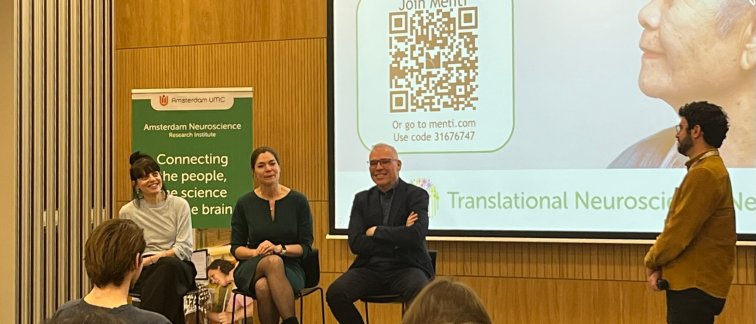
The morning symposium started with Prof. Dr. Henne Holstege, who presented on the 100-plus Study and pathways to cognitive resilience in extreme longevity. With unique access to a cohort of several dozen participants aged 100 and over, Holstege and her teams at Amsterdam UMC and VIB/KU Leuven aim to answer the question: “Which natural protective mechanisms do centenarians use to maintain brain health, and what can we learn from them?” With a heritability of 60%, studying genetics in detail is particularly interesting. She concluded her presentation by noting that almost all participants appear to be genuinely optimistic individuals.
Dr. Carlos Fitzsimmons of SILS continued with a presentation on understanding the link between brain injury and neurodegenerative diseases. As we age, we know that cognitive performance declines over time. While everyone ages, we do not all age in the same way. Fitzsimmons explored the long-term impact of traumatic brain injury (TBI), which affects millions of people worldwide each year. His group examined the cellular basis of TBI and the development of neurodegenerative disorders over the long term. TBI is now recognized as a major risk factor for chronic neurodegenerative diseases, as brain damage often extends far beyond the initial trauma site. Neuroinflammation appears to play a role in these long-term effects.
The morning concluded with Dr. Evgenia Salta from the NIN, who spoke about single-cell molecular mapping of human adult hippocampal neurogenesis in Alzheimer’s disease and resilience. She opened her presentation with the analogy: “If a computer crashes, you can press control-alt-delete to restart it. But when your brain crashes, as in Alzheimer’s and other neurodegenerative diseases, you can’t do that.” This is why Salta focuses on neurogenesis and how to study it in the adult brain using single-cell transcriptomics. Her team investigates the origin of immature neurons in the adult human hippocampus, how they are affected by Alzheimer’s disease pathology, and whether they can be recruited to ‘rejuvenate’ the degenerating brain and counteract memory loss.
After such an engaging morning session, the TN2 and Amsterdam Neuroscience teams are looking forward to the next full-day symposium on Thursday, 28 May 2026. Check it out here.