

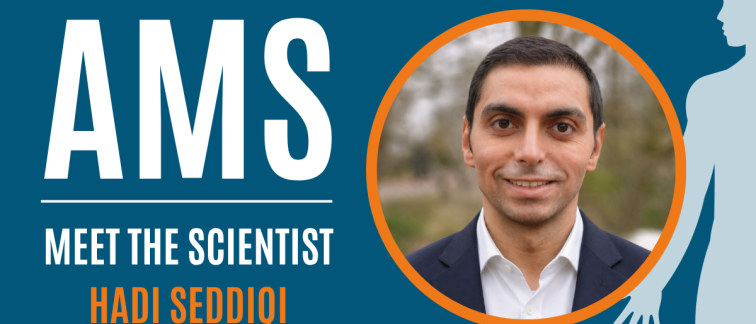
In our series of 'Meet the AMS scientist', we shine the light on outstanding AMS researchers and dive into their background, what drives them, what their work brings them and what they bring to their work. These interviews are also shared on the AMS LinkedIn account, feel free to share within your network!
Some scientific journeys are defined by discoveries. Others are defined by perseverance. For Hadi Seddiqi, both have played an important role. While building an international research career across engineering and biology, he has also navigated uncertainty about the future of his home country, Iran. Yet throughout every challenge, one thing has remained constant: his curiosity, eagerness to learn from others, and commitment to continuous growth.
Originally from a small city in Iran, Hadi always sought opportunities to push himself further. He first studied at the University of Tehran before moving on to Sharif University of Technology, one of Iran's leading engineering universities. Even then, his ambition extended beyond obtaining a degree. He wanted to continuously expand his knowledge, challenge himself, and learn from people with expertise different from his own.
That mindset eventually brought him to Amsterdam UMC. During his master’s studies, Hadi became involved in a bone tissue engineering project through a collaboration between researchers in Iran and the Netherlands. At the time, he knew little about cell biology or regenerative medicine. His expertise was computational modeling. Using engineering principles, he developed models to predict how bone implants would behave in the human body, including factors such as blood flow, oxygen transport, and cell growth.
What started as a two-month research visit in 2016 evolved into a decade-long scientific journey. Over the years, Hadi became the engineer in a multidisciplinary group of biologists, clinicians, biomechanists, and tissue engineers. Rather than seeing the differences in expertise as a barrier, he embraced them. Learning how others think became one of the most important parts of his work.
During his PhD, he published more than twenty scientific publications, accumulated more than 2,000 citations, and contributed to research that received international recognition. Yet when asked about his proudest achievements, Hadi does not immediately mention publications or awards. Instead, he speaks about collaboration.
For him, the most rewarding part of science is bringing together people from different backgrounds and learning from one another. Whether working with researchers in the Netherlands, Sweden, Japan, the Philippines, and Iran, he has consistently sought out opportunities to connect expertise across borders and disciplines.
Today, a new challenge shapes his future. While completing his PhD in The Netherlands, conflict and instability have affected life in Iran. Like many researchers working abroad, Hadi faces uncertainty about what comes next. His long-term goal remains clear: to return to Iran, become a professor, and use both his academic and industrial experience to solve practical challenges facing his country.
Research should ultimately lead to solutions that improve people’s lives, and for him, that proces begins with listening. By understanding different perspectives and bringing them together, it becomes possible to create solutions that no single discipline, or person, could achieve alone.
Find the article also on our LinkedIn.
Written by Elianne Prange (Communication Officer AMS)