
Janet MacNeil Vroomen, Majon Muller and Emiel Hoogendijk, researchers in the Amsterdam Public Health Aging & Later Life program, have published a commissioned Personal View in The Lancet Healthy Longevity on how to evaluate ageing in place reforms.
Between 2010 and 2020, most OECD countries reformed long-term care so that older adults could stay at home for longer. Few of these reforms have been evaluated beyond their effect on long-term care spending. Drawing on reforms in the Netherlands, Norway and Japan, the authors identify three recurring tensions: decentralisation versus coordination, personal versus collective responsibility, and cost containment versus investment. Every country needed substantial midcourse corrections.
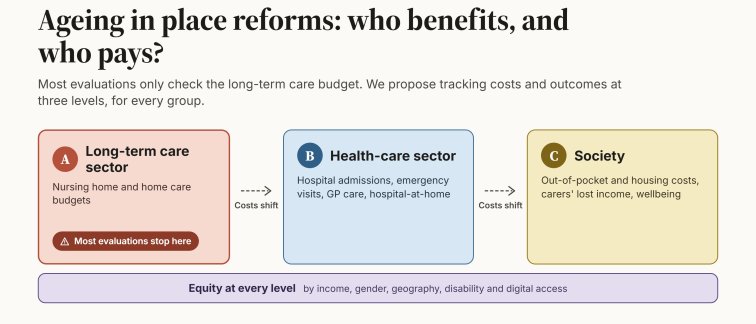
“Apparent savings can simply mean that costs have moved to hospitals, to older people themselves, or to unpaid family carers,” says first author Janet MacNeil Vroomen. “If we want to know whether ageing in place works, we need to look at who benefits and who pays.”
The authors propose an integrated, equity-stratified framework that follows costs and outcomes across long-term care, health care and society, with each outcome broken down by factors such as socioeconomic position, gender and place of residence.
The paper brings together expertise in health economics (Janet MacNeil Vroomen, Bram Wouterse), health equity (Professor Amélie Quesnel-Vallée, McGill University), frailty (Elsa Dent and Emiel Hoogendijk, co-chairs of the Lancet Commission on Frailty) and internal medicine and geriatrics (Professor Majon Muller).
Read the article: https://doi.org/10.1016/j.lanhl.2026.100929