

The origins of health – Bridging early development and future well-being
Our ambition at AR&D is to advance knowledge across all aspects of human reproduction and development – from preconception to adulthood – to improve the health of current and future generations. In perfect alignment with Amsterdam UMC’s overarching mission, "A Healthy Future for All," this year’s grant round specifically focuses on the profound relationship between early development and its effects on health later in life.
Science clearly shows that the foundations of health and disease are laid very early in life. AR&D researchers possess world-class expertise spanning fundamental biology, clinical care, epidemiology, and public health. By bringing together diverse disciplines, utilizing cutting-edge methodologies, and leveraging our unique datasets and biobanks, we can unravel how early life events program lifelong health trajectories.
Scope and inclusivity
This grant is open to all types of research within the AR&D scope. Whether your research is fundamental (biological/mechanistic), clinical, evaluative, epidemiological, translational, or focused on public health and implementation, your proposal is welcome, provided it aligns with the central theme of linking early development to health outcomes.
Proposals should make clear how they align with both the Relevance to the Theme (the extent to which the project contributes to understanding or optimizing early development and its effect later in life) and the Envisioned Impact (the potential of the results to significantly advance the scientific field, improve clinical care, or create tangible societal value).
Note that this impact could also be envisioned strategically, such as the proposed initiative positioning the team to secure large-scale (e.g., EU) grants that will eventually yield substantial impact. However, such strategic scenarios must be realistic and substantiated by concrete collaborations or preliminary data, rather than being purely speculative.
We strongly encourage "Team Science." By bridging the gap between basic scientists and clinicians, or between data scientists and public health experts, we can maximize our knowledge and create sustainable impact, whether that impact is a ground-breaking fundamental discovery or a direct improvement in patient care.
Examples of eligible projects include, but are not limited to:
- Fundamental & Mechanistic Research: Investigating cellular, genetic, or epigenetic mechanisms during gametogenesis, embryonic, or fetal development that influence disease susceptibility later in life (e.g., using in vitro models, organoids, or animal models).
- Clinical & Evaluative Research: Evaluating the long-term health outcomes of specific interventions, treatments, or diagnostic procedures performed during pregnancy, birth, or early childhood.
- Data, Cohorts & Epidemiology: Expanding existing cohorts or linking diverse datasets to study inheritance, environmental exposures, or lifestyle factors across multiple generations.
Funding details
The maximum budget awarded per project is €50,000.
It is possible to submit proposals for smaller, highly focused research projects or seed-funding initiatives. For larger projects exceeding €50,000, explicit co-funding should be readily available and demonstrated in the proposal.
Projects involving collaboration between different departments within Amsterdam UMC, or with faculties at our affiliated universities (UvA and VU), are highly encouraged.
Eligibility requirements
To be eligible to apply for the AR&D grants the following criteria need to be met:
- All grant applications must be submitted by an AR&D affiliated researcher (including PI’s) and supported by at least one AR&D Principal Investigator (PI), as evidenced by their PURE profiles.
- An applicant can submit only one proposal for the AR&D Research Grant 2026. An AR&D PI is however allowed to support more than one proposal as the responsible AR&D PI.
- Applicants who received an AR&D Research Grant in 2025 as main applicant are not eligible to submit a proposal for the AR&D Research Grant round 2026. They may submit again in the following year.
- Research proposals should be written in concise English with a clear research question or aim and should be understandable to a researcher in an adjacent science field within AR&D.
- All research proposals must include a clear and achievable timeline. Research projects must have a start date between November 1, 2026 and January 1, 2027, and must be executed at Amsterdam UMC/UvA/VU.
- All research proposals must include a financial plan. The budget must specify which costs pertain to which calendar year, based on the project’s start and end dates. If applicants come from multiple departments, it must be clearly indicated which costs are allocated to which department. The budget must be prepared in consultation with and approved (signed) by the lead applicant’s financial controller/project controller.
Guidelines conflict of interest
AR&D formulated guidelines regarding integrity and conflict of interest.
Application
The application form should include:
- Information of applicant(s) and affiliation(s)
- Project details
- Budget specification
- If applicable proof of co-funding
The application form can be downloaded here:
Convert the completed application form to a PDF-file and email your application to AR&D (ARandD@amsterdamumc.nl).
Submission deadline
The call is closed.
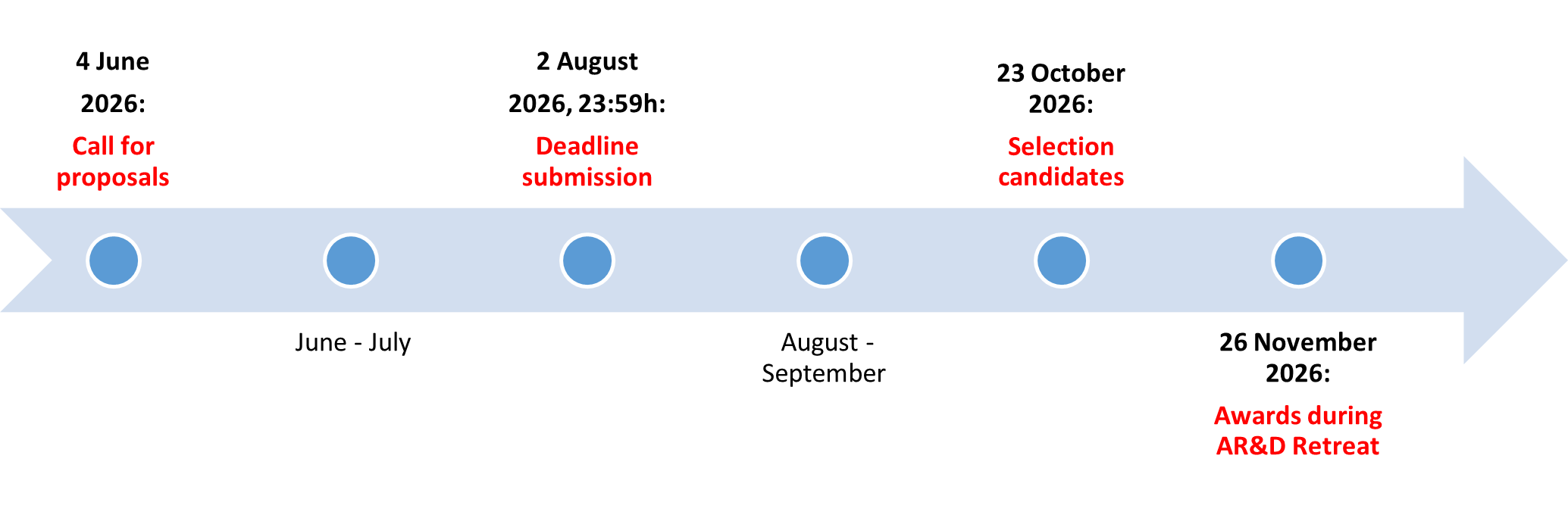
The deadline for submission was: 2 August 2026, 23:59 pm.
Incomplete applications, applications over the maximum word limit, and applications submitted after the deadline will not be taken into consideration.
Selection procedure
The submitted proposals will be assessed by an independent review committee based on the following criteria:
- Relevance to the Theme: The extent to which the project contributes to understanding or optimizing early development and its effect later in life.
- Envisioned Impact: The potential of the results to significantly advance the scientific field, improve clinical care, or create tangible societal value.
- Scientific Quality: The excellence, innovation, and robustness of the study design and research methods.
- Feasibility: The realistic execution of the research project within the proposed timeframe and budget.
Final report
All awarded proposals are obliged to send a final report to AR&D, using the format provided by AR&D, describing the results of the project within 3 months after finalization of the project. This report has to include an overview of the financial accountability.
Time line
Contact
For questions contact AR&D (ARandD@amsterdamumc.nl).