
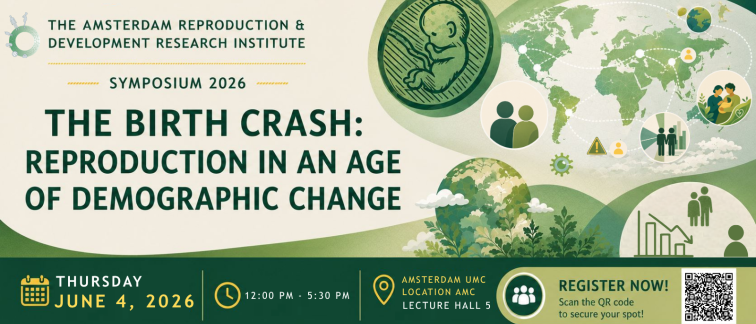
Opening reflections: rethinking parenthood and demographic change
The day opened with welcome remarks from the day’s chair, Hajar Yagkoubi, who introduced the central questions of the afternoon. Is having children still simply a personal choice? Are we at risk of medicalizing a social problem? What do children really need? And what role should healthcare, governments, and society play?
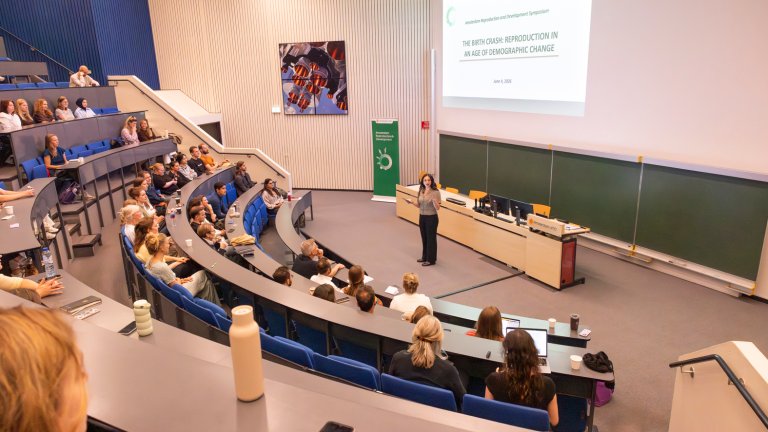
Photo credits: Martijn Gijsbertsen. Welcome remarks from Hajar Yagkoubi.
The scientific program began by inviting the audience to rethink expectations of parenthood and to reflect on what children truly need. In her contribution, Dr. Bernadette de Bakker (Embryology, Amsterdam UMC) set the tone for a broader discussion on the conditions required for healthy development, not only from a biological perspective, but also from a social and societal one.
The Dutch fertility puzzle was then explored through numbers, trends, and their wider meaning. In his talk, Prof. Gert Stulp(Computational Social Science, University of Groningen) placed declining fertility in a broader demographic and sociological context, showing that reproductive decisions are shaped by more than biology alone. Social expectations, economic conditions, education, relationships, and life-course choices all influence how many children people have, and when.
After this first part of the program, AR&D directors Sebastiaan Mastenbroek and Martijn Oudijk presented the AR&D Annual Report 2025. This was followed by an update on the AR&D Retreat in November 2026, and the opening of the AR&D Research Grant call, before the segment concluded with the award ceremony of the AR&D Travel Grant 2026-2027. Together, these moments highlighted AR&D’s continued commitment to supporting collaboration, reflection, and innovative research in reproduction and development.
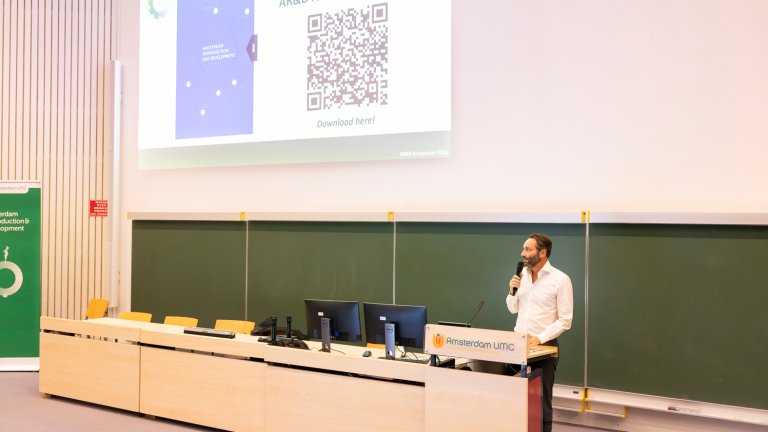
Photo credits: Martijn Gijsbertsen. Director Martijn Oudijk presenting the AR&D Annual Report 2025.
European perspectives: fertility, policy, and pressure
The second part of the symposium broadened the discussion from the Dutch context to wider European developments.
A European perspective was introduced through a contribution on what can be learned from France. Together, Dr. Femke Mol(Centre for Reproductive Medicine, Amsterdam UMC) and Prof. Samir Hamamah (Reproductive Biology and Medically Assisted Procreation, Montpellier, France)explored how France has recently taken major steps to address infertility and demographic change through a national prevention plan. Their talk raised important questions about what such an approach could mean for the Netherlands, and how prevention, information, reproductive autonomy, and access to care can be balanced.
Reproduction under pressure was examined from a social and economic perspective by Dr. Lucy van de Wiel(Global Health and Social Medicine, King's College London) addressed how reproductive technologies, fertility care, and broader societal developments are connected. Issues such as the financialization of fertility, delayed parenthood, and the growing role of reproductive technologies were placed in a wider social context.
The question of whether women should carry the weight of a societal crisis added an important ethical and political dimension to the afternoon. As chair of Stichting Ava, Alina Chakh emphasized that any discussion about declining birth rates must also address reproductive rights, gender equality, care responsibilities, and the unequal burden often placed on women. Without a fairer distribution of care, work, and parenthood, policies aimed at birth rates risk reinforcing existing inequalities.
A brief video glimpse of the European Population Conference which took place simultaneously in Bologna, Italy, highlighted the connection between the symposium, the Dutch debate, and international developments.
The patient perspective and panel discussion
The patient perspective brought the discussion closer to lived experience. On behalf of Stichting Vruchtbaarheid, Merel van den Berg focused on fertility, choice, and the emotional reality of reproductive decision-making. Her contribution highlighted the importance of timely, honest, and accessible information about fertility, while also recognizing the impact of fertility challenges on individuals and couples.
The symposium then continued with a panel discussion moderated by Hajar Yagkoubi under the title “The birth crash: crisis, choice or change?” The panel brought together Alina Chakh, Odine Aandewiel, Yousif Dawood, Dr. Lucy van de Wiel, and Prof. Gert Stulp to reflect on the many dimensions of the topic: from individual reproductive autonomy to public health, from housing and childcare to gender equality, and from medical care to political responsibility. Hajar also actively involved the audience, creating an engaging discussion in which participants could share their questions, reflections, and perspectives.
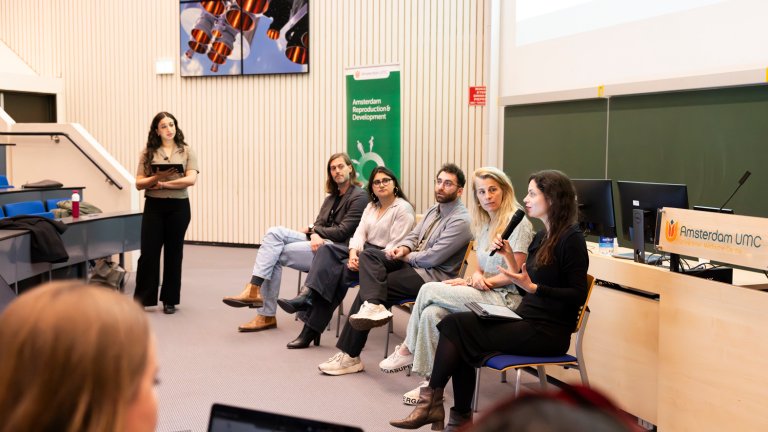
Photo credits: Martijn Gijsbertsen. From left to right: Hajar Yagkoubi, Prof. Gert Stulp, Alina Chakh, Yousif Dawood, Odine Aandewiel and Dr. Lucy van de Wiel.
The discussion made clear that the birth crash cannot be explained by one single factor. Participants reflected on the role of structural barriers such as housing costs, economic uncertainty, work-life balance, childcare, and unequal care responsibilities. At the same time, the panel emphasized the importance of protecting freedom of choice and avoiding pressure on individuals, especially women, to solve a societal issue through reproduction.
Where do we go from here?
The afternoon concluded with closing reflections by Hajar Yagkoubi, who brought together the key insights of the day. The symposium showed that demographic change is not only a question of fertility rates, but also a question of how society supports people, families, children, and future generations.
The Birth Crash invited participants to look beyond simple solutions. Fertility care, public health, social policy, gender equality, housing, childcare, and reproductive rights are all part of the same conversation. The day served as a reminder that reproduction is deeply personal, but also shaped by the world around us.
We thank all speakers, panel members, organizers, and participants for their valuable contributions and engagement. We look back on an inspiring and thought-provoking symposium, and we look forward to continuing this important conversation together.