

Young patients, limited options
In patients with a genetic predisposition, thoracic aortic aneurysms can develop at a relatively young age: when the vessel ruptures, patients are often only 25 to 35 years old. Apart from blood pressure-lowering medication, no specific therapy exists to protect their vessels, leaving preventive surgery as the only option for those at high risk. Earlier work by De Waard and Van der Pluijm suggests that the vessel wall cells in these patients are exhausted, possibly due to mitochondrial dysfunction.
A wound that never heals
What exactly goes wrong in the vessel wall? According to De Waard, the answer may lie in a wound healing response that is conserved from worms to humans. "When the environment of cells is damaged, growth factors are released that locally instruct cells to repair the damage by producing scar tissue," she explains. "Those same growth factors also make the mitochondria function at a lower setting." At a wound, oxygen supply is likely insufficient for oxidative phosphorylation, so cells switch to glycolysis, much like cancer cells do. Once the wound is healed, cells switch back.
In people with certain connective tissue diseases, however, the environment of the vascular cells is permanently altered. The repair program stays on and never switches back. The result: exhaustion of the vessel wall cells which, together with the weak connective tissue, leads to aneurysm formation.
From aging research and wound healing
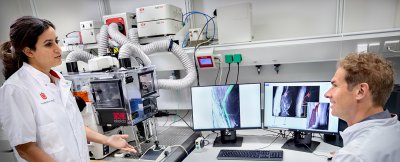
De Waard and Van der Pluijm study the same phenomenon, mitochondrial dysfunction in aneurysm disease, but each from a different background. Van der Pluijm knows mitochondrial dysfunction from the field of aging research, De Waard from wound healing. "We see that it plays a role in many cardiovascular diseases, and with this new study we try to get a grip on it," says De Waard. The researchers will study this in various aneurysm mouse and human cell models in Rotterdam and Amsterdam. Their two PhD students will work closely together, exchanging models and local expertise.
From diet to drug
How can the exhausted cells be recharged? A first clue comes from aging research. "We know that a thirty percent calorie restriction works well to counteract aging," says De Waard. "We want to study what underlies this effect, so that we can target it with a drug. Eating only seventy percent of your normal calories is no fun, and no patient will keep that up."
In addition, several compounds are already known to influence mitochondrial function, such as resveratrol and nicotinamide riboside. In aneurysm mouse models, the researchers will study how these compounds affect vascular smooth muscle cells, using single-cell RNA sequencing.
For the patients
For De Waard, the motivation is personal. "I became interested in genetic aneurysm disease because these relatively young patients receive no specific medication to properly protect their blood vessels, apart from blood pressure-lowering drugs," she says. "How can it be that in a world with so much medication, we still do not understand which medication can block aneurysm formation? I have been doing this research for sixteen years, so by now I have met many aneurysm patients, and then you know very well for whom you are doing this. That motivates!"
About the NWO Open Competition Domain Science-M
M-grants are intended for realizing non-programmed, curiosity-driven scientific research with impact. In this round, the NWO Science Board evaluated 75 grant applications and awarded seventeen of them. An overview of all awarded projects can be found on the NWO website.