
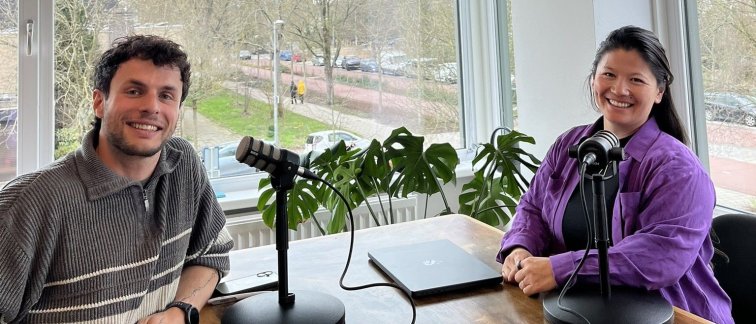
While birthdays are worth celebrating, ageing is the single biggest risk factor for the development of various diseases. The podcast guest, Dr. Laura Han, assistant professor at Amsterdam UMC, specialises in biological ageing, the way our bodies get older, and links it to psychiatry.
In the episode of the Stress Navigation podcast titled ‘Biological age and mental health with Laura Han', they explore the difference between calendar years (chronological age) and biological age. Biological ageing is the process of our bodies getting older. Han explains organs age in different ways than others, “It looks as if there is not one unitary process that controls ageing in a unitary way. (..) You can think of it as a car, a car has many different parts, and some parts need replacement sooner than others, ina bodythat's not very different”.
In her research, Laura Han connects biological ageing to psychiatry. Why? Because people living with mental illness show more signs of bodily wear and tear, compared to peers of the same age. People experiencing depression, for example, show an ’older’ brain compared to their chronological age. In this podcast we discuss the consequences of this brain age gap. Laura explains: “I think the problem is chronic stress, when your biological stress systems are constantly activated (...) that is really when it starts to be more problematic: your cells, your body and your brain are getting more wear and tear.”
The main goal of studying biological ageing is to help people live healthier lives. The research looks at ways to improve the health and habits of the whole population. One important idea is using a person’s biological age to better predict their risk of getting sick, choose the best treatments, and find ways to prevent diseases. This could help doctors give more personalised care to each person. This conversation offers an intuitive perspective that could reshape how we approach personalised medicine.
Stress in Action – about the project
Stress in Action is a research project where seven Dutch universities and UMC's collaborate in a 10-year research project on stress. Stress is complex and multifaceted, and we all experience it in our daily lives. Using novel measurement technologies and analyses, the consortium aims to measure the emotional, cognitive, biological and behavioural stress responses.
Stress in Action received the Gravitation Grant of the Dutch Research Council (NWO). In 2023, Stress in Action started building their consortium and launching their research to accomplish their ambitious goals in the coming 10 years. Currently, 100+ consortium members are working on various themes and projects. In large-scale population studies, we investigate which environmental and personal factors influence stress and how stress can lead to mental and cardio metabolic diseases. With the new knowledge, methods are being developed to monitor and reduce stress in daily life and thus prevent the onset of stress-related diseases.
More information on Stress in Action can be found on their website.
The podcast Stress Navigation is an initiative of Stress in Action. They publish episodes in Dutch and English. The English episodes are hosted by Marcos Ross, PhD candidate in the department of Psychiatry at Amsterdam UMC. Production of the podcast and communications is done by Anouk Weverling.