
Stretching with a constant force immediately increases range of motion more than holding a joint in a fixed position, according to research by movement scientist Guido Geusebroek. This finding could eventually contribute to improving treatments for people recovering from a stroke or living with conditions involving muscle spasticity.
Conditions such as stroke, paralysis and prolonged bed rest can cause muscles and tendons to become shorter and stiffer. “As a result, joints become less mobile and are less able to bend or extend. This can severely limit everyday movements, such as walking and getting dressed,” Geusebroek explains.
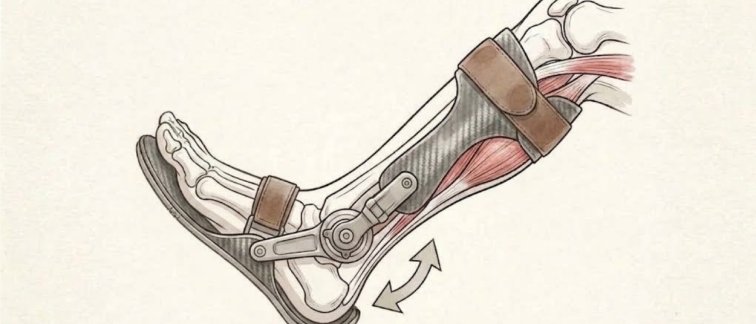
“Current treatments for joint stiffness include stretching shortened and stiffened muscles using splints, physiotherapy and automated stretching devices. However, there is still little scientific consensus on the most effective way to stretch,” the researcher says.
“My research therefore focuses on how different stretching methods affect joint mobility and the properties of muscle and tendon tissue.”
Constant force increases range of motion
The research consists of a literature review on ankle joint stiffness and three experiments using animal models. Geusebroek explains: “Previous literature studies involving patients showed that stretching with a constant force immediately increases the ankle joint’s range of motion more than other methods. However, there was not enough clearly reported data available to analyse the long-term effects.”
New animal model for studying joint stiffness
The first animal experiment confirmed that, in the short term, stretching with a constant force has a greater effect at the muscle and tendon level than stretching while maintaining a constant joint position. The second experiment investigated how the stretch was distributed across a calf muscle and tendon at the microscopic level.
Geusebroek: “In the third experiment, we developed a new model of ankle contracture in rats in which the ankle joint is not completely immobilised and the leg can still partially bear weight. This allows joint stiffness to be replicated more accurately in a rat model. The model can be used in future research to investigate the effectiveness of stretching and other treatment methods.”
Potential implications for rehabilitation
According to Geusebroek, the results are relevant to physiotherapists, rehabilitation physicians and developers of medical devices. “Splints and automated stretching devices may potentially stretch more effectively when they apply a continuous, constant force rather than holding the joint at one fixed position,” Geusebroek says.
He emphasises that further research is needed to determine the long-term effects of stretching with a constant force. “Ultimately, the results could contribute to optimising treatment guidelines and splint design in rehabilitation practice and potentially improve quality of life for people recovering from a stroke or living with conditions involving muscle spasticity,” the researcher concludes.
Copy and translation from VU article