
In our series of 'Meet the AMS scientist', we shine the light on outstanding AMS researchers and dive into their background, what drives them, what their work brings them and what they bring to their work. These interviews are also shared on the AMS LinkedIn account, feel free to share within your network!
For Lars, one question lies at the heart of his research: why do some people stick to exercise while others struggle to stay motivated? His research explores the intersection between mind and body, combining psychology and physiology to better understand what drives people to be physically active.
Traditionally, motivation has been investigated through questionnaires that ask people how motivated they feel. While these self-reports provide valuable insights, Lars and his colleagues suspect that motivation also leaves measurable traces in the body.
To explore the question of how those physiological responses relate to the psychological experience of motivation, Lars is currently setting up a large-scale study involving runners preparing for events ranging from half marathons to full marathons. The goal is ambitious: to identify predictors of exercise behavior and better understand when and why people choose to train, or not.
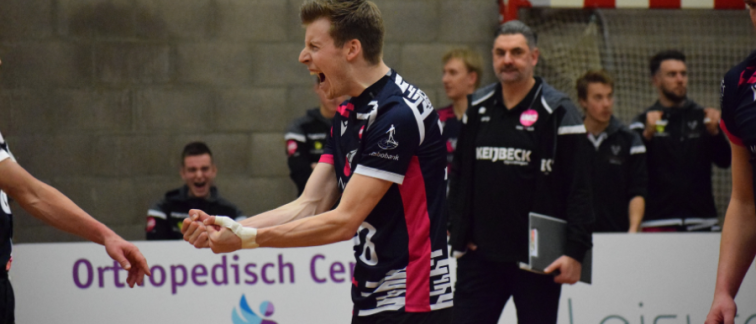
These questions resonate with Lars not only as a researcher, but also as an athlete. Before entering academia, he played volleyball at the highest national level in the Netherlands. However, after an unfortunate turn of events his trajectory changed. A serious knee injury, followed by multiple surgeries and a long rehabilitation process, forced him to step away from competitive volleyball.
With his athletic career coming to an end, Lars needed to find another path forward. After reaching out to researchers whose work interested him, he found a project that combined sports, physiology, psychology, and performance, bringing together all the fields that had fascinated him throughout his studies and athletic career.
Looking back, Lars sees this combination as more than coincidence. His background in Human Movement Sciences gave him a strong foundation in physiology, while a later interest in sport psychology broadened his perspective. Together, they formed the perfect basis for his current research.
What continues to fascinate him is the idea that performance is often determined in the margins. As a volleyball player, he was intrigued by the small adjustments that could make the difference between good and great performance. Today, he sees a similar principle in motivation research. Small changes in understanding, measuring, and influencing motivation could ultimately have a significant impact on public health.
Looking ahead, Lars hopes that his research will contribute to a society in which more people are able to maintain an active lifestyle. If researchers can better understand where motivation comes from, and how it changes over time, they may eventually be able to design interventions that help people stay active, even when motivation fluctuates.
Because in the end, motivation is not just about sports performance. It is about helping people make choices that benefit their health and well-being. And if we can better understand what drives those choices, we may be able to help more people keep moving, one step, one run, or one training session at a time.
Find the article also on our LinkedIn.
Written by Elianne Prange (Communication Officer AMS)