
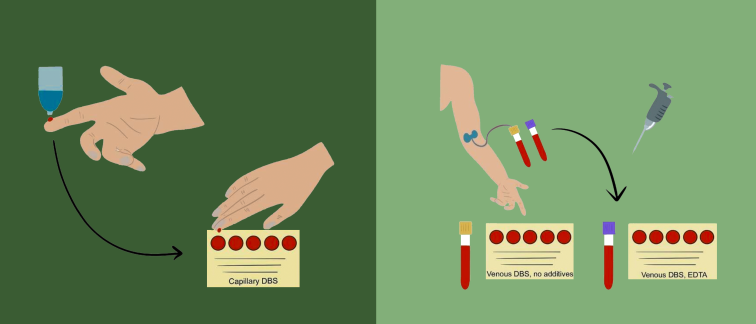
With just a little finger prick from home, dried blood spots can be obtained to run all sorts of blood tests which sounds quite easy and nice for patients, because that way hospital visits can be avoided. However, before the use of dried blood spot-sampling for hormone check-up can be widely applied in health care, laboratories must make sure that the whole process of collecting and measuring concentrations in dried blood spots for hormones is standardized and validated. A lot of research is needed for validation and, unfortunately, this process can be quite demanding for the hospital. Therefore, researchers from the Amsterdam UMC found a solution to avoid all the logistical hassle regarding the dried blood spot validation.
They discovered that leftover blood collected from the arm in tubes, called venous blood, can be used to make dried blood spots, by pipetting droplets of venous blood on filter paper (figure 1). Results of steroid hormone analysis are comparable to the results obtained from dried blood spots made from blood collected from a small blood vessel, called a capillary, via a finger prick. This means that laboratories can develop and validate new dried blood spot methods easier by using leftover blood from blood that hospitals already collect, without having to collect extra finger prick samples from volunteers.
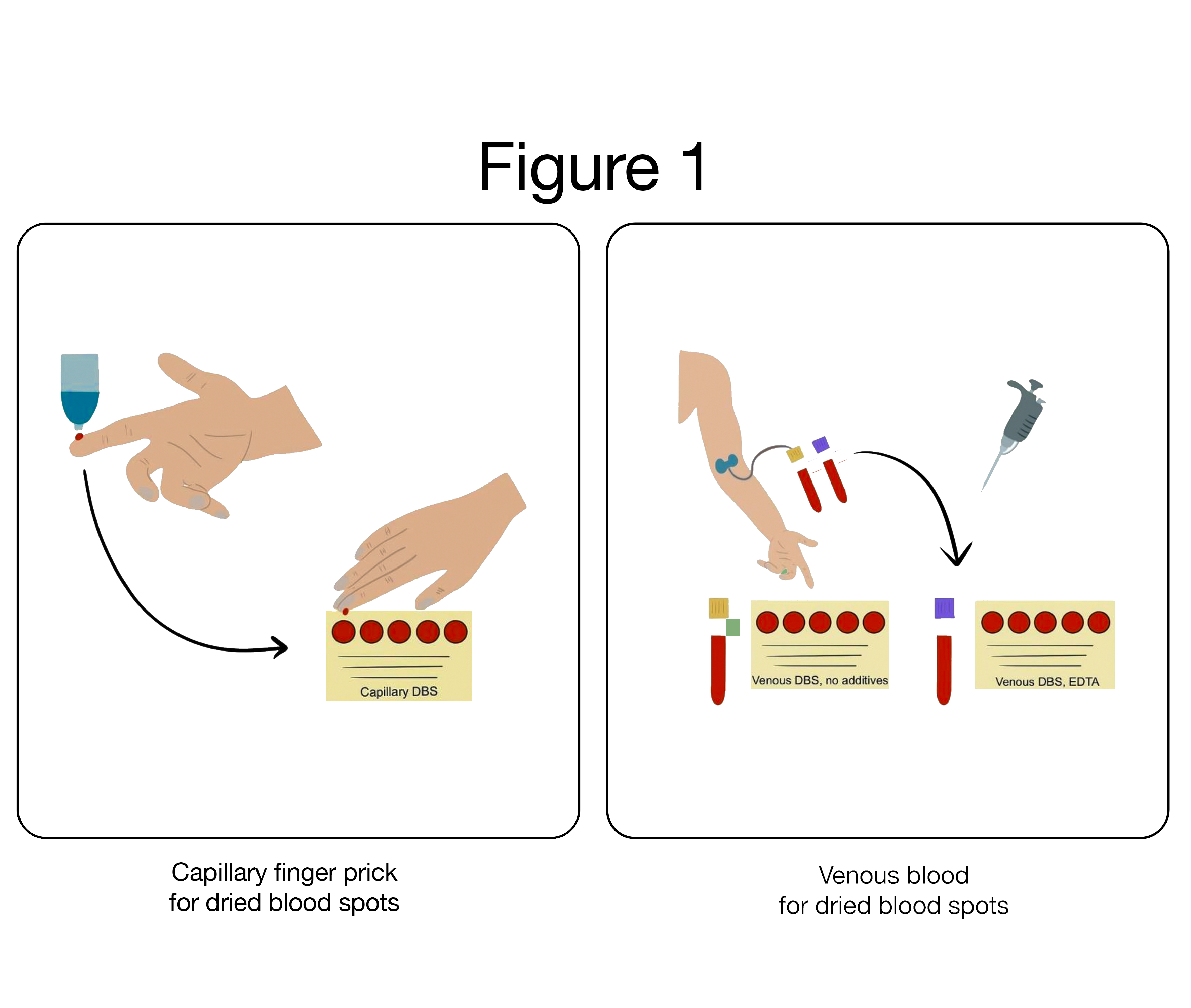 Illustration by: Rosalie Martens
Researchers at the Amsterdam UMC Endocrine Laboratory showed that analysis of droplets on dried blood spot cards from leftover venous blood can be used for the quantification and detection of most steroid hormones. Venous blood is routinely collected in the hospital in blood collection tubes, which are coated with special compounds, like EDTA, to prevent blood clotting. This routine leads to a wide availability of leftover blood from a large range of people. Using the leftover blood is therefore much easier and quicker to use than organizing blood collection via finger pricks. This study from the AGEM researchers shows a practical shortcut for obtaining material for developing new analysis methods, which can also help other laboratories around the world develop new analysis methods.
However, before the researchers came to that conclusion, they first had some concerns that needed to be addressed. They had to confirm that the measurement of steroids in blood that were in contact with EDTA in routinely used blood collection tubes would give the same results obtained from measurements of steroid hormones from capillary blood derived from finger pricks. To test this, the researchers compared dried blood spots from two different venous blood samples: one collected in EDTA-coated blood collection tubes and the other in tubes without additives. As it turned out, dried blood spots from both tubes showed a similarity between measurements of over 97%. Importantly, this was the case for all hormones.
Next, they wanted to know if venous blood and capillary blood would end in similar results during steroid hormone measurements. They performed a comparison between venous (hospital-sampled) and capillary dried blood spots (finger prick). The results obtained from this comparison were equally reassuring. For most steroid hormones, the similarity was over 89%, which is strong. That means venous dried blood spots can reliably mimic the capillary dried blood spots used in real-world patient care. This marks an important milestone, opening the door to many additional measurements from dried blood spots.
Authors
Amber Meurs
Amber Mater
Rosalie Martens