

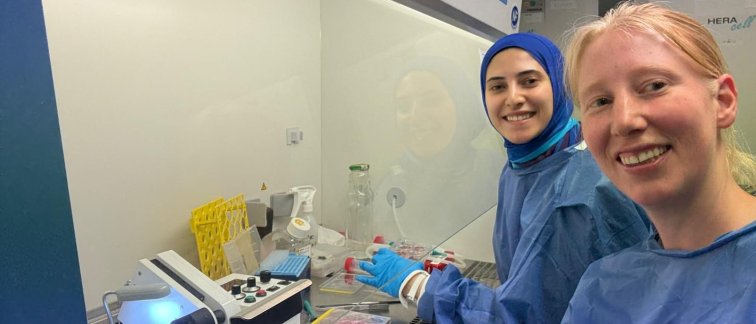
The Amsterdam institute for Immunology and Infectious diseases (AI&I) is committed to supporting innovative research and fostering international collaboration. In 2025, after 17 years at the Experimental Immunology lab, the AI&I International Work Visit Grant enabled research technician Annemiek Dijkhuis to spend two months at the lab of Dr. Aurélien Justet at the Centre Hospitalier Universitaire (CHU) in Caen, France. For two months Annemiek was emerged in a new research environment, gaining hands-on expertise in generating Precision Cut Lung Slices (PCLS) and performing single-cell RNA sequencing on these slices.
The PCLS model is a powerful tool for studying lung processes such as fibrosis, allowing researchers to manipulate and observe tissue mechanisms in detail. However, mastering the technique is not easily accomplished. The tissue must be carefully inflated with agarose to achieve the right stiffness for slicing, and the slices must be thin enough to remain viable during culturing. Annemiek’s time in Caen was dedicated to perfecting these skills, learning from experts, and overcoming technical challenges.
‘I am very grateful for the opportunity provided by the AI&I Work Visit Grant, it truly expanded my horizon.’
Annemiek Dijkhuis - Research technician, Experimental Immunology lab, Amsterdam UMC
Immediate impact
The knowledge Annemiek acquired in France was immediately put to use upon her return. In the months following her stay, the Amsterdam UMC team successfully generated multiple lung slices from different patients, giving their research a significant boost. Using PCLS allowed the team to study complex processes such as fibrosis within intact, multicellular tissue and to assess the effects of potential therapeutic compounds in a more physiologically relevant context. This helps accelerate translation from experimental treatments to the clinic and ultimately facilitate more personalized therapy. Moreover, PCLS is not limited to lung tissue and can be applied to other organs as well. The collaboration with Dr. Justet’s group in Caen has also proven invaluable. By exchanging knowledge and protocols, both teams have been able to strengthen their projects, enhance methodological quality and ultimately increase the impact and reach of their ongoing projects.
Growth
Previously, at the AMC, the team managed to generate only a few PCLS per experiment. In Caen, however, they were able to prepare almost 250 slices in a single day, enabling a large, well‑controlled experiment with many conditions. This was a major step forward and felt like a real breakthrough for Annemiek.
For Annemiek, the work visit was not only a technical learning experience but also a journey of personal growth. ‘In Caen we suddenly had almost 250 lung slices after one day of cutting, which allowed us to run a large experiment with many different conditions. That was a fantastic feeling and showed me how powerful it can be to step out of your familiar bubble and try something new. The AI&I Work Visit Grant is perfect for this: it gives you the opportunity to work in a different lab, exchange protocols and ideas, and come back with better methods and fresh perspectives,’ she reflects. Adapting to different equipment, reagents, and lab routines pushed her to innovate and collaborate, ultimately fusing the best practices from both labs.
For more information contact Annemiek Dijkhuis (a.dijkhuis@amsterdamumc.nl).
Text: Annemiek Dijkhuis and Esmée Vesseur
Learn more about our AI&I Work Visit Grant recipients:
Work Visit Grant / Meliawati Poniman’s Research on HCV Vaccine Research at Imperial College London (March 2026)
Work Visit Grant / Svearike Oeverdieck’s Experience at the University of Washington (March 2026)
Work Visit Grant / Nicholas Pucci’s Research on Antimicrobial Resistance in Tokyo (August 2025)