

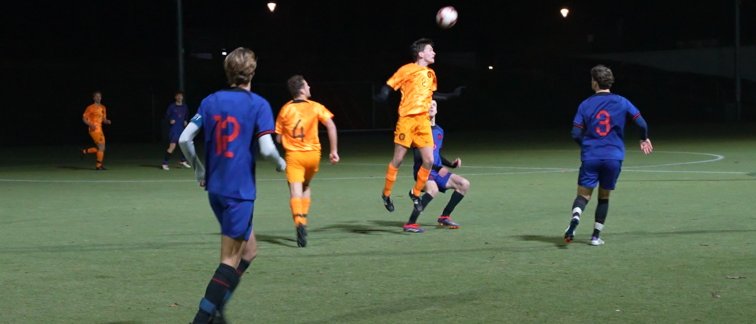
In 2025, the Health Council concluded that former professional soccer players have an increased risk of neurodegenerative disease, potentially due to cumulative exposure to repetitive head impacts such as heading the ball. “However the direct link between heading and brain damage had not yet been established, and we also knew very little about amateur soccer players,” said neuroscientist Marsh Königs of the Emma Children’s Hospital at Amsterdam UMC. “Amateur soccer is played less intensively, but the vast majority of players participate at this level. In this study, we examined whether real-life exposure to heading in amateur soccer is associated with changes in blood biomarkers of neural damage. For the first time, we were able to measure the direct effects of heading in amateur soccer.”

Video analysis
The researchers monitored more than 302 amateur soccer players during 11 men’s soccer matches, with each player participating in one game. Blood samples were collected before and after the match to measure specific biomarkers linked to brain cell damage. Physicians also use these biomarkers to diagnose brain injury and dementia. Video recordings were used to precisely track how often each player headed the ball and whether it was a high-intensity header, for example, following a long kick from the goalkeeper.
Greater effect with more frequent and harder headers
The results showed that players who headed the ball had higher levels of the p-tau217 and S100B biomarkers in their blood immediately after the match than players compared to the players who did not head the ball. The number of headers and their intensity also played a role. Königs: “The more often a player headed the ball and the more forceful the header, the greater the effect measured in the blood. The largest increase occurred after high-intensity headers, when the ball had traveled more than 20 meters through the air.”

Potential long-term damage
After the match, the biomarkers levels declined and returned to their original levels within 24 to 48 hours. Principal investigator and neurologist Jort Vijverberg of Amsterdam UMC: “We don’t know what this study says about permanent damage to the brain. In this study, we’re essentially looking at ‘dust clouds’ of damage. When the dust settles, that doesn’t mean the damage has disappeared.” Vijverberg therefore wants to emphasize that heading must be taken seriously, even in amateur soccer. “These acute effects could lead to long-term damage if they occur repeatedly. Whether this contributes to dementia remains uncertain, but the findings are important for shaping future policies on heading in soccer.”
Stricter rules
In response to the Health Council’s report on the risks of long-term brain damage and dementia, the Royal Dutch Football Association introduced stricter guidelines for heading in soccer beginning with the 2025/2026 season. The recommendations include significantly limiting heading among youth players and teaching safer heading techniques. With support from the Royal Dutch Football Association, Amsterdam UMC will continue follow-up research on heading, including studies involving women’s soccer.
Read the publication in JAMA Neurology: Amateur Soccer Heading and Acute Elevations in Blood-Based p-Tau217 and S100B
Image: Amsterdam UMC