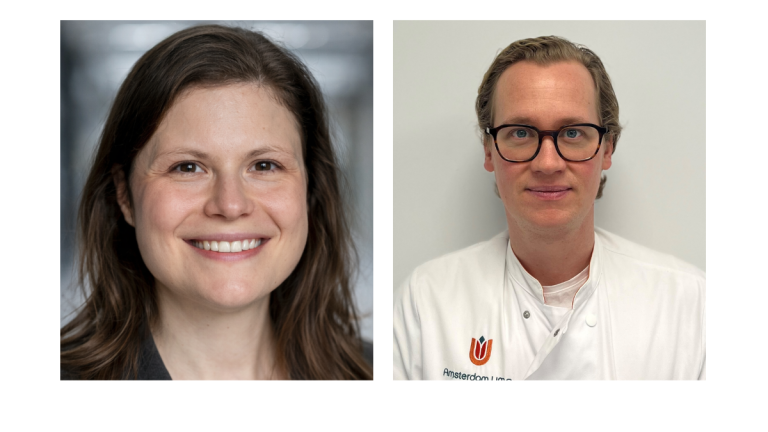

Three Amsterdam UMC researchers working on innovative cancer research have recently been awarded a Veni grant from the Dutch Research Council (NWO). This prestigious personal grant gives researchers the opportunity to further develop their own research over the next three years.
In this article, Leah Wilk and Jeroen de Groof share the scientific questions they aim to answer, what motivates them as researchers, and how their work could contribute to the future of cancer research.
Leah Wilk: using digital twins to personalise light-based cancer therapy
Leah Wilk investigates how photodynamic therapy can be better tailored to individual patients. In this treatment, a light-sensitive drug is administered and then activated with light to damage cancer cells.
The effectiveness of photodynamic therapy depends on several factors. These factors vary from patient to patient and can even change during treatment, making it difficult to predict exactly how the therapy will perform.
To address this challenge, Leah is developing a digital twin of the treatment: a computer model that calculates what happens inside the tissue during therapy. By combining these calculations with optical measurements taken during the procedure, she aims to investigate how treatments can be monitored and adjusted more precisely.
Her research focuses in particular on pancreatic cancer. For some patients, surgery is not possible because the tumour has grown around major blood vessels. A new form of photodynamic therapy is being developed to clear a margin of tumour tissue around the vessel to enable safe surgical tumour removal, with the aim of making surgical treatment possible for more patients. Leah's research aims to help optimise this technique and make treatment outcomes more predictable.
For Leah, the motivation behind this research is also personal.
"Several members of my family died from cancer at a relatively young age. That makes my motivation to contribute to better cancer treatments deeply personal."
At the same time, she is fascinated by the combination of physics, technology and medicine.
"Through this Veni grant, I want to bring computational models, optical measurements and clinical applications together in one adaptive system. I hope this will lay the foundation for treatments that can be tailored to each individual patient during the procedure, making them more effective, predictable and safer."
Jeroen de Groof: improving endoscopy with artificial intelligence
Jeroen de Groof investigates how artificial intelligence (AI) can improve the quality of gastrointestinal endoscopy.
AI systems are increasingly used to support physicians in detecting abnormalities during endoscopic procedures. However, their performance strongly depends on the quality of the examination itself. If an abnormality is not clearly visualised, AI systems are also less effective.
Jeroen is therefore developing computer-aided quality (CAQ) systems that use AI to monitor and improve the quality of endoscopic procedures. His research focuses on three applications: providing real-time quality feedback during colonoscopy, assessing the image quality of polyps and clinically validating a CAQ system for Barrett's oesophagus surveillance.
By improving the quality of endoscopic procedures, the research aims to reduce variation in clinical practice and increase the reliability and effectiveness of AI systems that assist physicians during endoscopy.
Jeroen has been working on AI applications in endoscopy for the past ten years.
"Technological advances over the past decades have enabled us to detect abnormalities earlier and treat them increasingly with minimally invasive techniques."
He believes AI will become an essential tool for supporting endoscopists.
"In this Veni project, I focus specifically on improving the quality of endoscopic procedures using AI. This enables endoscopists to provide even better care while simultaneously increasing the reliability and effectiveness of other AI systems used during endoscopy."