
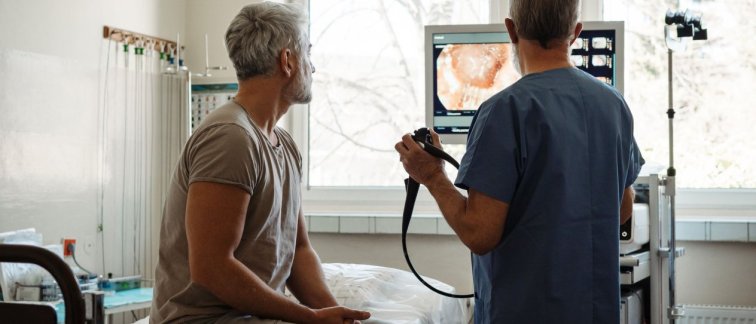
Patients in whom risky colon polyps have been removed only need a follow-up colonoscopy after five years instead of after three years. This is the conclusion of two European studies in which Amsterdam UMC was involved. The risk of colorectal cancer after removal of high-risk polyps is small, and a first check-up after five years is just as safe as after three years. In the Netherlands alone, this saves tens of thousands of colonoscopies per year: less burdensome for patients, for healthcare, and for the environment.
Amsterdam UMC is affiliated with a European research consortium that conducted both studies. This consortium carried out the largest study in the world on follow-up colonoscopies of patients with removed colon polyps. "The studies fit together perfectly," says Evelien Dekker, a gastroenterologist at Amsterdam UMC. "Together, they show that for these patients, waiting two years longer for the first check-up is just as safe. In the Netherlands alone, this saves tens of thousands of colonoscopies per year, without any additional cancer risk for the patient."
Waiting five years is just as safe
In one study, researchers, including Dekker, followed more than 10,700 patients in whom a so-called 'high-risk adenoma' had been removed: a polyp with an increased risk of developing into cancer. A first colon check-up after five years proved to be just as safe as the current interval of three years. In both cases, fewer than 1 in 100 patients developed colorectal cancer within five years.
Serrated polyps
In the second study, led by Dekker, more than 1,800 patients were followed after the removal of serrated polyps. Due to their appearance, these polyps are difficult to detect, but they can also develop into colorectal cancer. In 1 in 100 of these patients, colorectal cancer was found within five years; no one died from it. "That is a reassuring outcome," says Dekker. "The risk for this group is therefore just as small as for patients in whom a high-risk adenoma has been removed. Patients with removed serrated polyps therefore need to be checked only after five years as well."
Significantly reduced
Since the start of the national colorectal cancer screening programme in 2014, an increasing number of people have been undergoing colonoscopies. Those who have polyps often return for check-ups afterwards: in the Netherlands, approximately 55,000 of these follow-up examinations are performed each year. This is a growing burden on healthcare and on the patient, who must prepare for an invasive procedure each time. Moreover, every additional check-up places extra pressure on the environment. Thanks to this research, the number of follow-up colonoscopies after polyp removal can be significantly reduced. Care will then only be provided where it is truly needed.
Guideline immediately revised
The Dutch guideline for follow-up after polyp removal will be revised next year; Dekker chairs the working group revising the guideline. This aligns with Amsterdam UMC's 'Less is More' approach. A revision of the European guideline will also start at the same time. "In the Netherlands, we as a professional group are happy to go one step further," says Dekker. "Not only checking less often, but also looking more critically at who actually needs colon check-ups." A follow-up study for this purpose has already started, with funding from KWF (the Dutch Cancer Society).
The study was made possible by funding from KWF Kankerbestrijding (the Dutch Cancer Society). The results have been published in the scientific journal the New England Journal of Medicine.